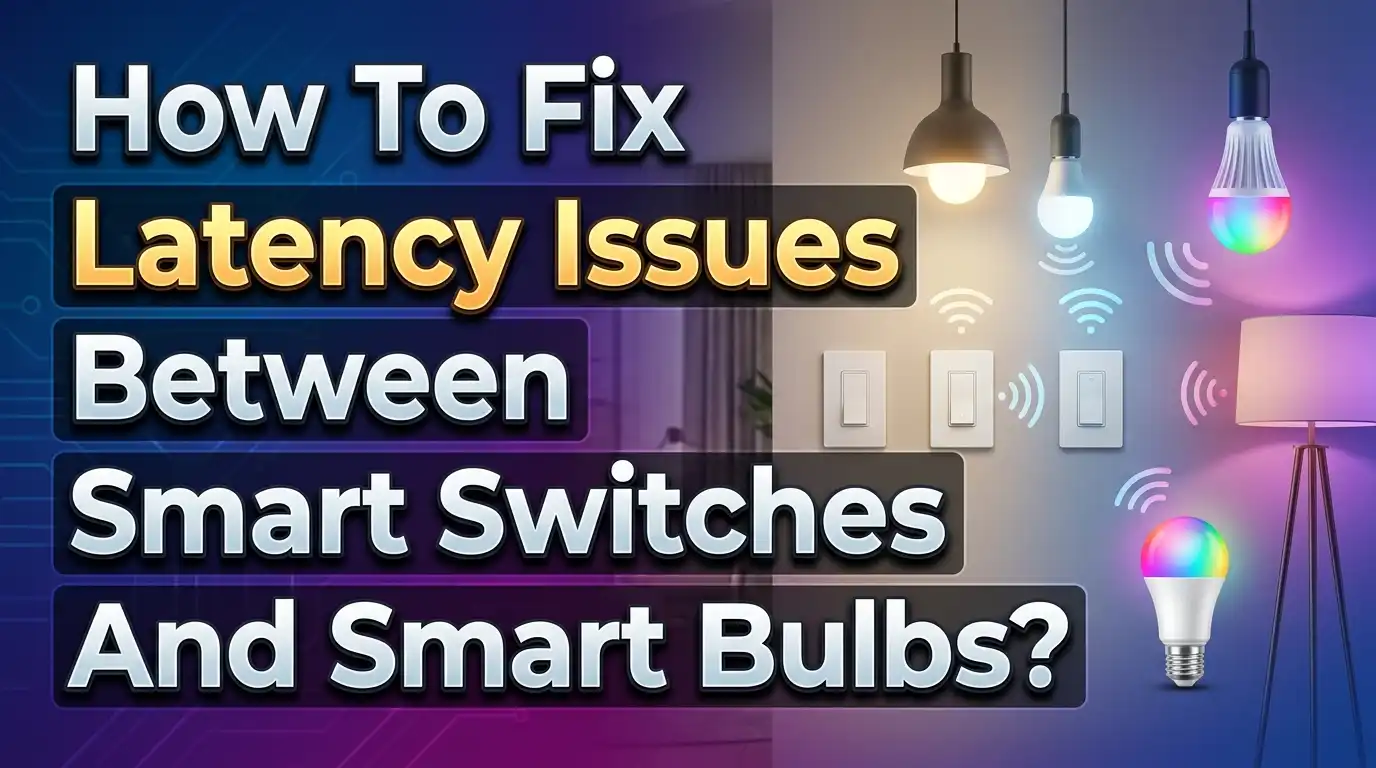
How To Fix Latency Issues Between Smart Switches And Smart Bulbs?
Latency between smart switches and smart bulbs can ruin the experience you paid good money for. It turns a futuristic setup into something that feels slower than a basic wall switch from the 1950s. The good news?
This problem is almost always fixable. The delay usually comes from a handful of identifiable causes like wireless interference, cloud processing bottlenecks, protocol mismatches, or poor device placement.
This guide will walk you through every practical fix, from the quickest wins to deeper technical solutions. Whether you use Zigbee, Z-Wave, WiFi, Thread, or Matter devices, you will find clear steps to eliminate that annoying lag and get your smart lighting responding the instant you press the switch.
Key Takeaways
- Smart switch to smart bulb latency is usually caused by wireless congestion, cloud dependency, or protocol mismatches between your devices. Identifying the root cause is the first step to a fast fix.
- Switching from cloud control to local processing can reduce response time from 2 to 10 seconds down to under 50 milliseconds. Platforms like Home Assistant and Hubitat process commands inside your home network without sending data to a remote server.
- 2.4 GHz WiFi congestion is one of the biggest hidden causes of smart bulb lag. Separating your IoT devices onto a dedicated network band or SSID frees up bandwidth and reduces packet delays.
- Zigbee direct binding between smart switches and smart bulbs eliminates the hub from the command chain entirely. This creates a device to device link that responds almost instantly.
- Firmware updates, DHCP reservations, and correct hub placement solve many latency issues without any cost. These are simple maintenance steps that many smart home owners overlook.
- Mixing too many protocols and platforms in one automation chain stacks delays on top of each other. Keeping your ecosystem unified under one protocol reduces the processing overhead that causes lag.
What Causes Latency Between Smart Switches And Smart Bulbs
The delay between pressing a smart switch and seeing a smart bulb respond has a chain of causes. Each link in the communication chain adds a small amount of processing time. When several slow links stack together, the delay becomes very noticeable.
The most common cause is cloud dependency. Many smart switches send commands to a manufacturer’s cloud server before the server relays the instruction back to the smart bulb. This round trip through the internet adds anywhere from 800 milliseconds to over 3 seconds of delay. During peak internet usage hours, the delay often gets even worse.
Wireless interference is the second major culprit. Smart devices that use WiFi operate on the crowded 2.4 GHz band. This same band carries signals from laptops, baby monitors, Bluetooth speakers, microwave ovens, and your neighbor’s WiFi. When the airwaves are busy, commands get delayed or lost entirely.
Protocol mismatch also creates lag. If your smart switch communicates using Z-Wave and your smart bulb uses Zigbee, a hub must translate between the two protocols. This translation step adds processing overhead. Each additional platform or service in the chain, such as Alexa, Google Home, or IFTTT, introduces another processing hop.
Weak mesh networks also contribute to slow response. Zigbee and Z-Wave devices form mesh networks where signals hop from one device to another. If a bulb sits at the far edge of the mesh with only one weak path back to the hub, its response time suffers.
Check Your Network For 2.4 GHz WiFi Congestion
WiFi congestion on the 2.4 GHz band is the single most overlooked cause of smart bulb latency. Every WiFi smart switch and WiFi smart bulb in your home competes for airtime on this narrow frequency range. Add cameras, streaming devices, tablets, and phones, and you have a traffic jam.
Start by logging into your router’s admin panel. Look at how many devices are connected to the 2.4 GHz band. If you see 20, 30, or more devices fighting for the same radio, latency problems are almost guaranteed. Routers with weak processors struggle to manage this many simultaneous connections.
Set your 2.4 GHz channel to a fixed option. Most experts recommend channels 1, 6, or 11 because they do not overlap with each other. When your router is set to “auto,” it may switch channels frequently. This causes smart devices to momentarily disconnect and reconnect, which feels like lag.
Separate your smart home devices onto a dedicated SSID. Create a network name like Home_IoT_2G for all your smart bulbs, smart switches, and plugs. Move your phones, laptops, and streaming devices to the 5 GHz or 6 GHz band. This gives your IoT devices a cleaner, less congested radio channel.
Disable aggressive router features like band steering, smart connect, and AI optimization during testing. These features can kick devices between bands unpredictably, causing connection drops and delayed responses.
Move From Cloud Control To Local Processing
Cloud processing is one of the biggest sources of latency in a smart home. Every time your smart switch sends a command through the cloud, that signal must travel from your home to a data center, get processed, and travel back. This round trip adds 1 to 5 seconds of delay on average.
Local processing eliminates this bottleneck entirely. When commands stay inside your home network, the response time drops to 15 to 45 milliseconds in most setups. That is fast enough to feel instant to the human eye.
Home Assistant and Hubitat are the two most popular local processing platforms. Both run on hardware inside your home and process automations without any internet dependency. If your internet goes down, your lights still respond. This reliability is a major advantage beyond just speed.
To make the switch, you need a compatible hub or a small computer running the platform. Many Zigbee, Z-Wave, and Thread devices integrate directly with these local platforms. WiFi devices often still need cloud connections, so consider replacing your slowest WiFi bulbs with Zigbee or Thread equivalents for the best results.
Review your existing automations after migrating. Remove any routines that route through multiple cloud services. A single, locally processed automation will always be faster than one that hops through Alexa, then a cloud server, then a hub, and finally the bulb. Shorter command paths mean faster lights.
Reduce Protocol Mismatches In Your Setup
Mixing too many wireless protocols under one roof creates a translation problem. Each time a command must be converted from one protocol to another, your hub needs processing time. That processing time shows up as lag.
A Z-Wave smart switch talking to a Zigbee smart bulb is a classic example. The hub receives the Z-Wave signal from the switch, translates it into a Zigbee command, and then sends it to the bulb. This translation can add 200 to 800 milliseconds of delay. If a cloud service sits in between, the delay grows much larger.
The best fix is to standardize your protocol. Pick one primary wireless standard and stick with it. If most of your devices are Zigbee, choose Zigbee switches to pair with your Zigbee bulbs. The same applies to Z-Wave or Thread. A unified protocol removes the translation step.
Matter is an emerging standard that helps solve this problem. Matter creates a common language across different device brands. When both your switch and bulb speak Matter, especially Matter over Thread, they can communicate without protocol translation. This keeps latency low and reliability high.
If you cannot replace all your devices immediately, prioritize the pairings that matter most to you. Start with the switches and bulbs you use daily. Replace the switch or the bulb so both operate on the same protocol. You will notice the improvement right away in those specific rooms.
Use Zigbee Direct Binding For Instant Response
Zigbee direct binding is one of the fastest ways to eliminate latency between a smart switch and a smart bulb. This feature creates a direct communication link between two Zigbee devices, bypassing the hub entirely for basic on, off, and dimming commands.
Without binding, the command path looks like this: switch sends signal to hub, hub processes the signal, hub sends signal to bulb. With binding, the path becomes: switch sends signal directly to bulb. This shortcut removes the hub processing step and delivers near instant response.
To set up Zigbee binding, both your switch and your bulb must support it. Brands like Inovelli offer switches with a dedicated smart bulb mode and Zigbee binding support. Many Philips Hue bulbs, IKEA Tradfri bulbs, and other Zigbee standard bulbs accept binding from compatible switches.
The setup process depends on your platform. In Home Assistant using ZHA or Zigbee2MQTT, you can configure bindings through the device settings. You select the source device (the switch) and bind it to the target device (the bulb or bulb group). Once the binding is active, pressing the switch triggers the bulb with no hub delay.
Keep in mind that direct binding handles basic commands. Complex automations, color changes, or conditional triggers may still require hub processing. But for the most common action, which is turning a light on or off, direct binding provides the fastest possible response time in a Zigbee network.
Optimize Your Hub Placement And Connection
Your smart home hub acts as the brain of your system. If it sits in a poor location, every device in your home suffers from delayed communication. Hub placement is a free fix that many people ignore.
Place your hub in a central, open location. A hub hidden inside a cabinet, tucked behind a TV, or shoved into a closet has its wireless signal weakened by walls and obstacles. Zigbee and Z-Wave hubs need a clear signal path to all connected devices. Even moving a hub one or two meters out of a confined space can reduce latency noticeably.
Keep your hub away from your WiFi router. This sounds counterintuitive, but WiFi routers produce heavy 2.4 GHz radio noise. Zigbee devices operate on frequencies that overlap with WiFi channel interference zones. Placing your Zigbee hub directly next to a router creates constant signal competition. A distance of at least one meter between the router and the Zigbee hub is a solid starting point.
Always use a wired Ethernet connection for your hub if possible. Connecting your hub to the router with an Ethernet cable removes wireless variability from the equation. The hub communicates with your router at full speed, and only the last hop between the hub and the bulb uses wireless.
Avoid placing hubs near USB 3.0 devices. USB 3.0 ports and cables emit radio frequency noise in the 2.4 GHz range. External hard drives, USB hubs, and docking stations with USB 3.0 can degrade your Zigbee signal quality. Move these devices away from your hub or use shielded USB cables.
Strengthen Your Zigbee Or Z-Wave Mesh Network
A weak mesh network causes commands to take longer to reach distant devices. Zigbee and Z-Wave devices form mesh networks where each powered device acts as a relay point. If your mesh has gaps, the signals must take longer, less reliable paths.
Add powered repeater devices to fill coverage gaps. Any Zigbee or Z-Wave device that stays plugged into wall power, such as smart plugs, in-wall switches, or hardwired bulbs, acts as a mesh repeater. Battery powered sensors and remote controls do not repeat signals. Strategically adding a smart plug between your hub and a distant bulb creates a stronger relay path.
Check your mesh network map regularly. Platforms like Home Assistant, Hubitat, and the Philips Hue app provide tools to visualize your Zigbee mesh. Look for devices that connect through only one weak path. If a smart bulb has a single route back to the hub through one distant repeater, its response time will be inconsistent.
Distribute your powered devices evenly throughout the home. Clustering all your smart plugs and switches in one room while leaving another room empty creates a dead zone. The bulbs in that dead zone must stretch their signal to reach the nearest repeater, which increases latency and drop rates.
After adding new repeater devices, give the mesh 24 to 48 hours to stabilize. Zigbee networks automatically reroute traffic over time. The mesh will discover the new devices and update its routing tables. You may notice improvements gradually rather than immediately after adding a new repeater.
Reserve IP Addresses And Fix Router Settings
Dynamic IP address changes can cause unexpected latency spikes for WiFi smart devices. When your router assigns a new IP to a device, other systems may temporarily lose track of it. This brief confusion shows up as a delayed response or a “device not found” error.
Create DHCP reservations for your most important smart home devices. Log into your router’s admin panel and assign static IP addresses to your smart hub, smart bridge, and any WiFi smart switches or bulbs that experience frequent lag. This ensures every device keeps the same address permanently.
Switch your router’s DNS to a faster provider. Some ISP default DNS servers are slow, especially during peak evening hours. Changing to a reliable public DNS service can shave a few hundred milliseconds off every cloud based command. Configure this change directly in your router so all devices benefit.
Disable QoS gaming modes that deprioritize IoT traffic. Some routers ship with quality of service settings that give priority to gaming or streaming traffic. These settings can starve your smart home devices of bandwidth, making commands queue up behind video streams. Either disable QoS entirely or configure it to treat IoT traffic fairly.
Reboot your router, hub, and smart devices in the correct order. Power cycle your modem first, then your router, then your smart home hub, and finally your voice assistants. This sequence clears stuck network tables, renews DHCP leases, and forces all devices to reconnect cleanly. Many latency issues disappear after a proper ordered reboot.
Update Firmware On All Your Smart Devices
Outdated firmware is a silent cause of smart home latency. Manufacturers regularly release updates that fix bugs, improve wireless performance, and optimize how devices communicate. Running old firmware means you miss out on these speed improvements.
Check your smart hub firmware first. Whether you use a SmartThings hub, Hue Bridge, or Home Assistant, make sure the hub software is current. Hub updates often include improvements to Zigbee and Z-Wave routing algorithms that directly reduce command processing time.
Update your smart switch firmware. Many smart switches receive over the air updates through their companion apps. Inovelli, Zooz, Lutron, and other manufacturers push firmware patches that fix delay issues, improve button response timing, and optimize mesh participation. Check the manufacturer’s app or website for the latest version.
Update your smart bulb firmware too. Philips Hue, IKEA Tradfri, and other Zigbee bulbs receive regular updates through their respective bridge or hub. These updates can fix transition timing bugs, improve dimming response, and resolve compatibility issues with third party switches.
Set a reminder to check for firmware updates every two to three months. Most smart home devices do not update automatically. A quick firmware audit takes only a few minutes and can prevent new latency problems from developing. After updating, run a quick test by triggering your most used scenes and automations to confirm everything works faster, not slower.
Simplify Your Automation Chains
Long automation chains create compounding delays. Each step in an automation adds processing time. When multiple cloud services, hubs, and platforms are involved in a single action, the total delay can become very noticeable.
Map out the path of your most used automations. Write down every step: what triggers the action, which platform processes it, and which device receives the final command. For example, a chain like Alexa receives voice command, sends to Alexa cloud, Alexa cloud sends to SmartThings cloud, SmartThings cloud sends to hub, hub sends to Zigbee bulb has four processing hops. Each hop adds delay.
Reduce the number of hops to a minimum. The fastest automation has a direct trigger and a local response. A Zigbee switch sending a bound command directly to a Zigbee bulb is one hop. A locally processed automation on Home Assistant that receives a Z-Wave switch event and fires a Zigbee bulb command is two hops. Both are fast.
Avoid using IFTTT or other third party cloud services for time sensitive lighting automations. These services add an external cloud processing step that can introduce 1 to 5 seconds of additional delay. Use them only for non critical automations where a few seconds of lag does not matter.
Use group commands instead of individual device commands. When you trigger a scene that controls five bulbs, sending one group command is faster than sending five individual commands in sequence. Most Zigbee and Z-Wave hubs support group broadcasting, which delivers the command to all bulbs simultaneously rather than one at a time.
Avoid Using Smart Switches And Smart Bulbs That Conflict
Not all smart switches are designed to work with smart bulbs. Using the wrong combination can create latency problems and even damage your devices. Understanding the compatibility rules prevents a lot of frustration.
A standard smart dimmer switch should not control a smart bulb. Smart dimmers regulate power by rapidly adjusting the electrical current. Smart bulbs have their own internal electronics that expect a constant, full power supply. When a dimmer reduces power to a smart bulb, the bulb’s processor becomes unstable. This causes flickering, delayed response, and sometimes total failure.
Use switches with a dedicated smart bulb mode. Brands like Inovelli offer switches that can disable the physical power relay and instead send wireless commands. In this mode, the switch keeps full power flowing to the bulb at all times while sending Zigbee or Z-Wave commands to control the bulb’s state. This eliminates the electrical conflict entirely.
If your switch does not have a smart bulb mode, consider a smart button or scene controller instead. These devices do not connect to the electrical circuit at all. They sit on the wall and send wireless commands to your hub, which then controls the smart bulb. This approach gives you physical wall control without any power interruption risk.
Always check the manufacturer’s compatibility notes before pairing a smart switch with a smart bulb. Some switches explicitly state they are not compatible with smart bulbs. Ignoring these warnings leads to inconsistent behavior that looks like latency but is actually an electrical conflict causing the bulb’s processor to restart repeatedly.
Use Thread And Matter For Future Proof Speed
Thread and Matter represent the newest generation of smart home communication standards. They were specifically designed to solve the latency, reliability, and compatibility problems that older protocols struggle with.
Thread is a low power mesh networking protocol built on IPv6. Unlike Zigbee, which uses a proprietary network layer, Thread devices use standard internet protocol addressing. This means commands travel more efficiently and do not require translation gateways. Thread networks also self heal and self optimize, automatically finding the fastest path for each command.
Matter is the application layer that runs on top of Thread, WiFi, or Ethernet. Matter gives devices a common language regardless of manufacturer. A Matter smart switch from one brand can control a Matter smart bulb from a completely different brand with no compatibility issues and no cloud requirement.
Matter over Thread is the ideal combination for low latency smart lighting. Commands stay entirely local, travel through an efficient mesh, and use standardized communication. Early adopters report response times under 100 milliseconds for switch to bulb commands using Matter over Thread.
To get started, you need a Thread border router. Many recent Apple TV models, HomePod Minis, Google Nest Hubs, and some SmartThings hubs include built in Thread border routers. If you already own one of these devices, you may already have Thread support in your home without realizing it. Add Matter certified switches and bulbs to start experiencing the speed improvement.
Test And Measure Your Latency Improvements
After making changes, you need a structured way to confirm that latency has actually improved. Guessing based on feel alone can be misleading. A simple test routine gives you clear before and after data.
Start by testing with the device manufacturer’s own app. Open the Hue app, Kasa app, or whatever app your bulb uses. Toggle the bulb on and off ten times. Note the average response time. If the bulb responds instantly here, your Zigbee or WiFi connection to the bulb is healthy. Any remaining delay is coming from higher in the stack.
Next, test through your smart home hub. Open Home Assistant, Hubitat, or SmartThings and toggle the same bulb. Compare this speed to the manufacturer app test. If the hub is significantly slower, your hub may need optimization, a firmware update, or better placement.
Then test through voice assistants. Say a simple command like “turn on the lamp” ten times through Alexa, Google Assistant, or Siri. This tests the full command chain including voice processing, cloud lookup, hub communication, and bulb response. If voice is the slowest link, the delay is in the cloud processing or DNS layer.
Test at different times of day. Run the same tests during quiet morning hours and again during busy evening hours when the family is streaming video. If latency spikes only during peak usage, your router or internet connection is the bottleneck. This points you toward router upgrades, QoS adjustments, or separating your IoT network.
When To Replace Devices Instead Of Troubleshooting
Sometimes the best fix is admitting a device has reached its limits. Older smart switches and bulbs may lack the features needed for a responsive modern setup. Knowing when to replace saves you hours of fruitless troubleshooting.
Replace cloud only WiFi smart bulbs that have no local control option. Some older WiFi bulbs require a cloud connection for every single command. No amount of router optimization will fix the inherent round trip delay. Swapping these for Zigbee, Thread, or Matter bulbs gives you local control and dramatically faster response.
Replace routers that cannot handle many IoT connections. ISP provided routers often have limited RAM and weak processors. When you connect 20 or more smart devices, these routers slow down under the load. A modern WiFi 6 or WiFi 7 router with a stronger processor handles smart home traffic much more effectively.
Replace smart switches that lack smart bulb mode or direct binding. If your switch physically cuts power to a smart bulb, you lose the ability to send wireless commands. Upgrading to a switch with smart bulb mode, Zigbee binding, or scene controller functionality gives you the fast response path you need.
Consider the total cost of your time. If you have spent several hours troubleshooting a single bulb or switch, the cost of a replacement device is often less than the value of your lost time. A $30 Zigbee switch that responds instantly is a better investment than endless troubleshooting of a $15 device that was never designed for your use case.
Prevent Latency Issues From Coming Back
Fixing latency once is great. Keeping it fixed requires a small amount of ongoing maintenance. A few simple habits will keep your smart home responding quickly over the long term.
Check for firmware updates every two to three months. Set a recurring calendar reminder. Log into your hub, open your device apps, and install any available updates. Manufacturers frequently release patches that improve speed and fix wireless bugs. Staying current prevents new latency issues from developing.
Review your automations twice a year. Remove old test routines, duplicate scenes, and abandoned device triggers. These leftover automations can slow down your hub’s processing as it evaluates rules that no longer serve a purpose. A clean automation list means faster execution for the rules that matter.
Monitor your network when you add new devices. Every new smart device joins the 2.4 GHz competition. Before adding a batch of new bulbs or sensors, check your current device count and router performance. If you are approaching your router’s device limit, plan for a network upgrade before problems start.
Keep a simple document of your setup. Record your device protocols, IP reservations, Zigbee channel, WiFi channel, and hub placement details. When something breaks or you add new devices, this reference saves you from starting your troubleshooting from scratch. A five minute documentation habit prevents hours of future confusion.
Reboot your entire smart home system once a month. A scheduled reboot of your modem, router, hub, and voice assistants clears accumulated memory leaks and refreshes connection tables. This simple routine keeps everything running at peak speed with minimal effort.
Frequently Asked Questions
Why is there a delay when I press my smart switch to turn on a smart bulb?
The delay usually comes from the command path between the switch and the bulb. If the switch sends a signal to a cloud server before the server relays it to the bulb, that internet round trip adds 1 to 5 seconds. WiFi congestion, protocol translation between different wireless standards, and weak mesh network connections also contribute to the lag. Switching to local processing, using direct Zigbee binding, and reducing WiFi congestion are the most effective fixes.
Can I use a smart dimmer switch with a smart bulb?
Using a standard smart dimmer with a smart bulb is generally not recommended. Smart dimmers regulate electrical current, but smart bulbs need constant full power to operate their internal electronics properly. The power fluctuations cause flickering, delayed responses, and potential damage. Instead, use a smart switch with a dedicated smart bulb mode that keeps full power flowing while sending wireless commands to control brightness.
Does WiFi congestion really affect smart bulb response time?
Yes, WiFi congestion is one of the biggest causes of smart bulb lag. Most smart home devices operate on the 2.4 GHz band, which is shared with dozens of other household devices. When this band is crowded, commands get queued, delayed, or dropped entirely. Creating a separate SSID for IoT devices, setting a fixed WiFi channel, and moving non IoT devices to the 5 GHz band significantly reduces this congestion.
What is the fastest protocol for smart switch to smart bulb communication?
Zigbee with direct binding and Matter over Thread currently offer the fastest response times. Zigbee direct binding creates a device to device link that bypasses the hub entirely, delivering near instant response. Matter over Thread uses efficient local mesh networking with standard IP addressing and typically achieves response times under 100 milliseconds. Both are significantly faster than cloud dependent WiFi communication.
How often should I update firmware on my smart home devices?
Check for firmware updates every two to three months. Smart home manufacturers release regular patches that fix bugs, improve wireless performance, and enhance device compatibility. Keeping your hub, switches, and bulbs updated prevents new latency problems from developing. After each update, test your most used scenes and automations to confirm that everything works correctly.
Will a better router fix smart home latency?
A better router can help significantly if your current one is overloaded. ISP provided routers often have limited processing power and struggle with 20 or more connected smart devices. Upgrading to a modern WiFi 6 or WiFi 7 router with a stronger processor improves connection stability and reduces latency for WiFi based smart devices. However, if your latency is caused by cloud dependency or protocol mismatches, a new router alone will not solve the problem. Address those issues alongside any hardware upgrades.