How to Optimize Smart Lighting for Indoor Houseplant Health?
Your indoor plants are probably starving for light, and you may not even know it. A room that looks bright to your eyes can feel like deep shade to a Monstera or a fiddle leaf fig.
Smart grow lights give you full control over light intensity, duration, and spectrum. They allow you to automate schedules, adjust brightness on the fly, and match your lighting setup to each plant’s unique needs. But here is the thing.
Simply plugging in a grow light does not guarantee results. You need to understand what kind of light plants use, how much they need, and how to schedule it properly for real, lasting health improvements.
This guide walks you through every step. Whether you have a single pothos on a desk or an entire shelf of tropical aroids, you will learn how to get smart lighting right.
Key Takeaways
- Indoor light drops sharply with distance from windows. A spot just a few feet from the glass can be too dim for most houseplants to grow well. Smart grow lights fill that gap by providing consistent, measurable light where natural sunlight falls short.
- PPFD is the most useful metric for plant lighting. Forget lumens and watts. PPFD (Photosynthetic Photon Flux Density) tells you exactly how much usable light reaches your plant’s leaves. Most tropical foliage plants thrive between 100 and 200 PPFD, while succulents and cacti need 300 or more.
- Full spectrum white LEDs are the best choice for home use. They support plant growth across all stages and make it easy to spot signs of disease or stress. Red and blue “blurple” lights work but are harsh on human eyes and hide visual cues on leaves.
- Timers and smart plugs are essential for consistent results. Plants respond best to a predictable daily light cycle of 12 to 14 hours for tropical foliage. Smart plugs offer more reliability and flexibility than built in timers on most grow lights.
- Light distance matters as much as light strength. A powerful LED panel placed too far away delivers weak light. A small bulb placed too close creates hot spots. Always check the manufacturer’s PPFD chart at your specific mounting distance.
- Seasonal adjustments keep plants healthy year round. Reduce supplemental light in bright summer months and increase it during the short, dim days of winter. A fixed setup that never changes will underperform during at least part of the year.
Why Indoor Plants Need More Light Than You Think
Most people assume a well lit room provides enough light for houseplants. This is one of the biggest mistakes in indoor plant care. Human eyes adjust to low light quickly, but plant leaves do not. A south facing window in winter may only deliver around 100 to 300 PPFD at its peak, and that peak lasts for just a few hours.
Move a plant two meters away from that same window, and light levels can drop below 50 PPFD. North facing windows and interior rooms often sit below 5 PPFD, which is too low for almost any active plant growth. Glass itself reduces light transmission. Add curtains, blinds, dust on the glass, or a nearby building casting shadow, and your plant’s usable light shrinks further.
Plants that do not get enough light show clear signs. Stretched, leggy stems mean the plant is reaching for more light. Smaller new leaves indicate it lacks the energy to produce full sized foliage. Yellowing lower leaves signal that the plant is dropping old tissue it cannot afford to maintain. Many people mistake these symptoms for overwatering or nutrient problems, but light is often the real cause. Smart lighting solves this by delivering a precise, consistent dose of usable light regardless of window direction, weather, or season.
Understanding the Light Spectrum Plants Actually Use
Plants do not use light the same way humans see it. They absorb specific wavelengths for photosynthesis, growth regulation, and protective pigment production. The range that drives photosynthesis is called Photosynthetically Active Radiation (PAR), covering wavelengths from 400 to 700 nanometers. This includes blue, green, and red light.
Blue light (400 to 500 nm) promotes compact growth, strong stems, and healthy leaf development. It is especially important for seedlings and foliage plants. Red light (600 to 700 nm) drives photosynthesis most efficiently and plays a key role in flowering and fruiting. Green light (500 to 600 nm) was once thought to be wasted, but research shows it penetrates deeper into leaf tissue and supports photosynthesis in lower canopy layers.
Full spectrum white LEDs combine all of these wavelengths in a balanced output that mimics natural sunlight. This makes them the best choice for most home growers. Red and blue “blurple” lights can grow plants, but they cast an unpleasant pink glow and make it hard to spot pest damage, disease, or nutrient deficiencies on leaves. For a home setting, a clean white full spectrum LED gives you the best of both worlds: strong plant support and a pleasant living environment.
PPFD, DLI, and the Metrics That Actually Matter
Grow light shopping gets confusing fast. Many products advertise watts, lumens, and color temperature. None of these numbers tell you what your plant actually receives. PPFD (Photosynthetic Photon Flux Density) is the measurement that matters. It tells you how many usable light photons hit a square meter of leaf surface per second.
Think of it this way. Lumens measure brightness for human eyes. Watts measure how much electricity a fixture uses. PPFD measures how much food your plant can make from the light it receives. A 60 watt LED might deliver strong or weak PPFD depending on its efficiency, lens design, and distance from the plant.
Another useful metric is DLI (Daily Light Integral). DLI measures the total amount of usable light a plant gets over 24 hours. It is calculated by multiplying PPFD by the number of seconds the light is on. Most tropical foliage houseplants do well with a DLI of 4 to 8 mol per square meter per day. Succulents and flowering plants may need 12 or more. When you shop for a grow light, look for products that list PPFD values at specific distances. If a light only shows watts and lumens, you are guessing about actual plant performance.
How Much Light Do Different Houseplants Need
Not all plants need the same amount of light. A ZZ plant and a desert cactus have very different requirements. Matching your smart light output to your plant type is one of the most important steps you can take.
Low light plants like ZZ plants, snake plants, and aspidistra do well with 50 to 100 PPFD. These are the toughest plants for dim rooms and dark corners. Medium light plants like Monstera, Philodendron, Pothos, and Calathea prefer 100 to 200 PPFD. This is the sweet spot for most common tropical foliage houseplants. High light plants like Hoya, succulents, and cacti need 200 to 500 PPFD or more to maintain compact, healthy growth.
Fruiting plants such as indoor citrus or pepper plants demand 500 to 1000+ PPFD and long daily light periods. If you are growing these indoors, you will need a powerful panel light, not just a small LED bulb. The best approach is to start low and increase gradually. Place your plant under a new light at moderate intensity for 7 to 10 days. If new growth looks compact and healthy, you are on track. If leaves bleach, curl, or develop crispy edges, reduce the intensity or increase the distance.
Choosing the Right Type of Smart Grow Light
The right grow light depends on your space, your plants, and your aesthetic preferences. There is no single best option. Here is how to match light format to your setup.
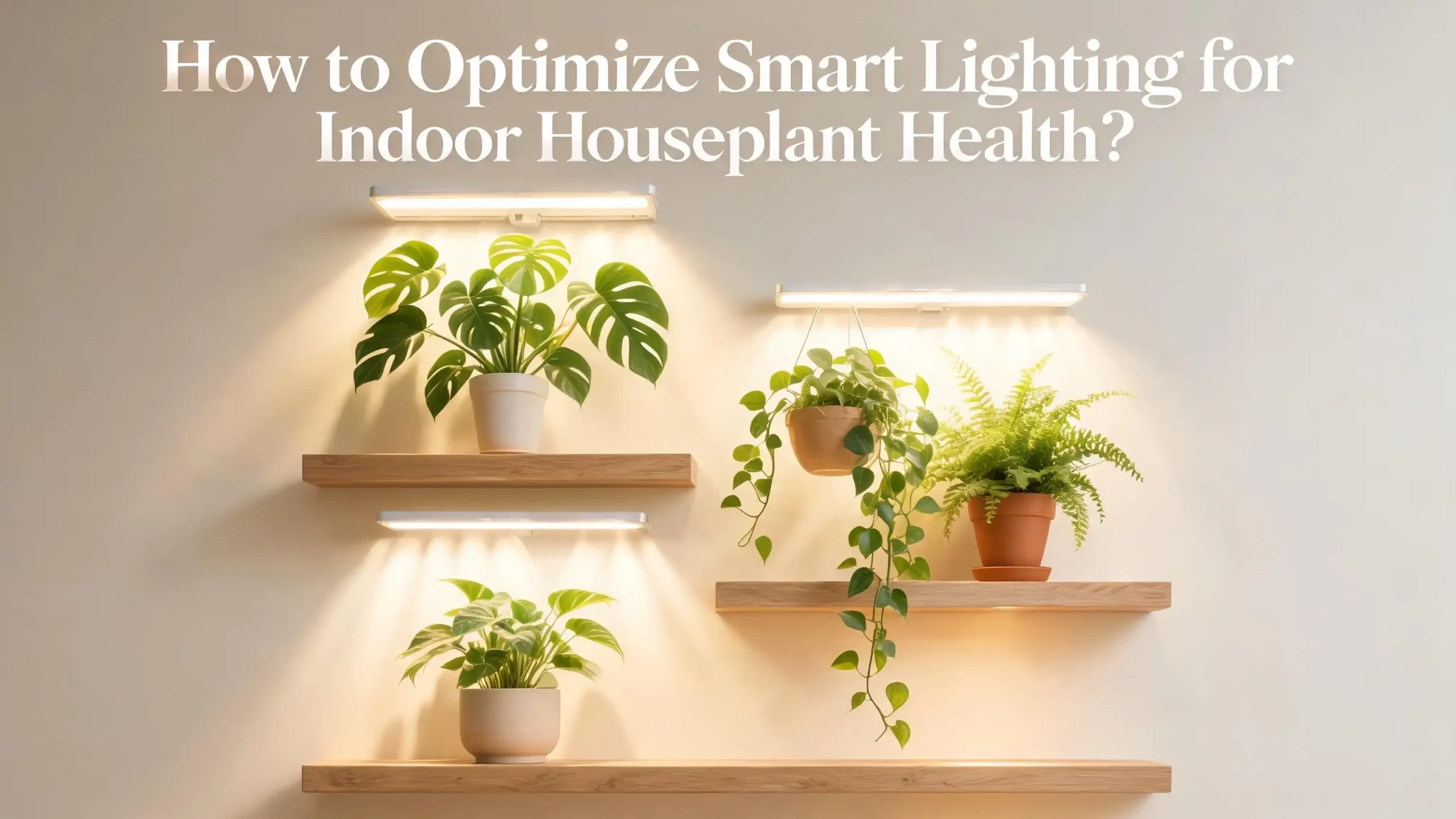
LED bulbs screw into standard lamp sockets and work well for individual plants. They are affordable and easy to use. The downside is that they create a single bright spot with weaker edges. LED light bars are better for shelves and plant walls. They spread light evenly across a wider area and look clean in most home setups. LED panels deliver strong output over large areas and suit high light plants, grow tents, or dedicated plant rooms. They can be too intense for delicate foliage if placed too close.
Clip on LED lights suit desks and temporary setups. They are convenient but often weak. Always check the actual PPFD output before relying on one for a light hungry plant. Smart LED grow bulbs with WiFi or Bluetooth connectivity let you control brightness, set timers, and monitor usage from your phone. Some integrate with smart home systems like Google Home or Apple HomeKit. For most houseplant shelves, LED bars with a smart plug offer the best combination of even coverage, reliable scheduling, and clean appearance.
Setting the Right Light Distance for Your Plants
A grow light’s distance from your plant canopy changes everything about how much usable light the leaves receive. Too far away, and the light is too weak. Too close, and you risk heat stress or light burn.
Fluorescent tubes should sit about 10 to 20 centimeters above plant tops because their intensity drops quickly with distance. Standard LED bulbs and small strips work best at 15 to 30 centimeters. LED bars perform well at 20 to 35 centimeters. High output LED panels need 30 to 60 centimeters or more of clearance, depending on their power.
Always check the manufacturer’s PPFD chart. It shows you exactly how much usable light the fixture delivers at various distances. A light rated at 300 PPFD at 15 centimeters might only deliver 100 PPFD at 30 centimeters. That difference matters. After placing your light, watch your plants for 7 to 10 days. Good signs include compact new growth, stronger stems, and steady leaf size. Warning signs include bleached patches, curling leaves, and crispy edges on exposed foliage. Adjust distance in small increments rather than making dramatic changes.
Creating the Perfect Smart Lighting Schedule
Consistency is one of the easiest ways to improve plant health. Plants respond best to a predictable daily cycle of light and darkness. Random on and off patterns cause stress and poor growth.
For most tropical foliage houseplants, aim for 12 to 14 hours of light per day. This provides enough energy for steady growth without disrupting normal plant rhythms. Seedlings and cuttings do well with 14 to 16 hours because their small leaves need extra time to absorb energy. Herbs and leafy greens also benefit from longer days. Flowering plants are different. Some need short nights, while others need long, uninterrupted dark periods to set buds. Christmas cactus and poinsettia are classic short day plants. If your smart lights stay on past sunset during autumn, these plants may never bloom.
Use a smart plug or a WiFi enabled timer rather than a built in timer on the light itself. Built in timers often reset after a power outage, defaulting to an always off position. A smart plug lets you set precise schedules, adjust remotely, and monitor energy usage. Link your smart plug to a routine in your home assistant app for true automation.
Using Smart Home Automation for Plant Lighting
Smart home systems take grow light management to the next level. Instead of manually flipping switches, you can build automated routines that adjust lighting based on time, season, and even cloud cover.
Smart plugs are the simplest entry point. Pair any grow light with a WiFi smart plug and set daily on and off schedules through the companion app. Most smart plugs also let you create sunrise and sunset routines that gradually ramp light up and down, which mimics natural daylight transitions. Smart home hubs like Google Home, Amazon Alexa, or Apple HomeKit let you group multiple lights into scenes. You can create a “Plant Morning” routine that turns on all your grow lights at 7 AM and a “Plant Night” routine that turns them off at 9 PM.
For advanced users, platforms like Home Assistant allow you to integrate light sensors, temperature monitors, and humidity readings. You can set rules like “turn on the grow light if the ambient light sensor reads below 100 PPFD” or “dim the grow light if the temperature sensor reads above 30 degrees Celsius.” This level of automation removes guesswork and ensures your plants receive optimal light regardless of changing weather or seasons.
Recognizing and Fixing Light Related Problems
Even with smart lighting, problems can arise if the setup does not match the plant’s needs. Learning to read your plant’s signals helps you make fast corrections.
Stretched, leggy stems with long gaps between leaves mean the plant is not getting enough light. Move your grow light closer or increase the daily duration. Pale or faded leaves can signal either too little light or too much. Check which leaves are affected. If lower leaves fade, the plant may be dropping old tissue to save energy. If upper leaves bleach, the light is too strong. Leaves curling upward often indicate heat stress from a light placed too close or insufficient airflow around the fixture.
No new growth during active growing months usually points to low daily light intake. Increase your DLI by raising either the intensity or the hours. Soil staying wet for too long is another indirect sign. A plant in weak light uses water more slowly, making a normal watering routine feel like overwatering. Before you adjust your watering, check your lighting first. Many watering problems are actually light problems in disguise.
Adjusting Smart Lighting Through the Seasons
A static lighting setup that never changes will underperform during parts of the year. Plants experience seasonal shifts even indoors. Natural daylight gets shorter and weaker in winter and longer and stronger in summer.
In winter, natural light in many regions drops below usable levels for tropical houseplants. Run your smart grow lights for 12 to 14 hours daily and consider lowering the fixture slightly to increase intensity at leaf level. Do not push plants into fast growth with excess fertilizer during this time. Instead, focus on maintaining healthy, compact form. In spring, natural light increases and plants resume active growth. You can begin raising your grow light slightly as window light strengthens.
In summer, strong direct sun through windows can combine with grow lights to create excess light and heat. Dim your smart lights or reduce their hours if plants also receive bright natural sun. Watch for signs of heat stress. In autumn, start extending your grow light schedule before you notice stretching or smaller leaves. Catch the seasonal decline early rather than waiting for visible damage. A 15 minute adjustment every two weeks is a smooth way to transition between seasonal schedules.
Managing Heat and Airflow Under Grow Lights
LEDs run much cooler than older HID or incandescent fixtures, but they still produce heat. In enclosed spaces like shelves, cabinets, and terrariums, that heat can build up and harm both plants and equipment.
Keep leaf level temperatures below 30 degrees Celsius for most tropical houseplants. Use a small clip on fan to circulate air around the light fixture and plant canopy. This prevents hot spots and helps strengthen stems through gentle air movement. In glass fronted cabinets or enclosed shelves, leave gaps for ventilation at the top or sides. A sealed cabinet with a strong LED light can become an oven within hours.
Check the temperature at the warmest point after the light has been running for several hours. If you feel significant heat when you hold your hand at plant height, either raise the fixture or increase ventilation. In humid terrariums, long light periods combined with warm, stagnant air also encourage algae growth on moist surfaces. Balance light duration with airflow, regular cleaning, and rest periods. Never enclose high wattage fixtures in small, unventilated spaces. Heat buildup damages plants, wiring, and the light fixture itself.
Measuring Your Indoor Light Levels Accurately
Guessing does not work. The only way to know if your plants are getting enough light is to measure it. The good news is that you do not need expensive professional equipment to get useful readings.
Phone light meter apps like Photone offer surprisingly accurate PPFD readings for white LED and sunlight sources. Hold your phone at leaf height, take readings at morning, midday, and late afternoon, and average the results. This gives you a clear picture of your plant’s daily light exposure. Phone apps are less accurate under narrow spectrum red and blue LEDs, so keep that in mind.
For serious growers, a dedicated PAR meter provides the most precise data. It measures PPFD directly and lets you map strong and weak zones across your growing area. This is especially useful if you run multiple lights or have tiered shelving where top and bottom plants receive very different intensities. Map your growing area once per season. A spot that delivers 200 PPFD in June might drop to 50 PPFD in December if it relies partly on window light. Recording these numbers helps you make smarter adjustments before problems appear.
Common Mistakes to Avoid with Smart Grow Lights
Even experienced plant owners make avoidable errors with grow lighting. Here are the most frequent problems and how to prevent them.
Using the wrong metric to evaluate a light. Watts and lumens do not tell you what the plant receives. Always check PPFD at your actual mounting distance. Placing lights too high. A fixture mounted at the ceiling may look tidy but delivers almost no usable light to a plant on a low shelf. Every extra inch of distance reduces PPFD significantly.
Running lights 24 hours a day. Plants need a daily dark period. Photosynthesis happens during the day, but important processes like starch conversion and flowering signals rely on predictable darkness. Ignoring the edges of the light footprint. A grow light is brightest directly below it. Plants at the edges receive less light and may stretch or grow unevenly. Rotate plants weekly or add a second fixture for wider coverage.
Forgetting seasonal adjustments. A schedule that works in July will not work in January if your plants also rely on window light. Skipping acclimation. Moving a plant from low light into bright grow light overnight can shock it. Increase light exposure gradually over 7 to 14 days to let the plant adjust its leaf chemistry and moisture management.
Step by Step Guide to Setting Up Your First Smart Grow Light
If you are starting from scratch, follow these steps for a setup that works from day one.
Step 1: Identify your plant’s light needs. Look up the recommended PPFD for each species. Group plants with similar requirements together under the same light. Step 2: Choose a light format that fits your space. LED bars work best for shelves. Bulbs work for single plants. Panels work for large collections or high light species.
Step 3: Mount the light at the manufacturer’s recommended distance for your target PPFD. Step 4: Connect the light to a smart plug and set a daily schedule. Start with 12 hours on and 12 hours off for tropical foliage. Step 5: Measure PPFD at leaf height using a phone app or PAR meter. Adjust the distance until you hit your target range.
Step 6: Watch your plants for 7 to 10 days. Look for compact new growth as a positive sign. Adjust if you see stretching, bleaching, or curling. Step 7: Review and adjust your schedule at the start of each season. Increase hours in autumn and winter. Decrease hours in spring and summer if natural light is strong. Step 8: Clean your light fixture monthly. Dust on the LEDs reduces output over time. A quick wipe keeps your light performing at its best.
Frequently Asked Questions
Can I use regular LED bulbs as grow lights for houseplants?
Yes, regular LED bulbs can support houseplants if they are bright enough and have a color temperature around 5000K or higher. However, they typically produce lower PPFD than dedicated grow lights. A standard 800 lumen bulb may work for low light plants like pothos or snake plants if placed very close. For medium or high light plants, a dedicated full spectrum grow light delivers more usable photons per watt and produces better results.
How many hours per day should I run my grow light?
Most tropical foliage houseplants do well with 12 to 14 hours of light per day. Seedlings and herbs may benefit from 14 to 16 hours. Short day flowering plants like Christmas cactus need shorter light periods and long uninterrupted nights to form buds. Always provide at least 8 hours of darkness. Running lights 24 hours a day stresses plants and disrupts important biological processes.
How do I know if my plant is getting too much light?
Watch for bleached or faded patches on the upper leaves closest to the light. Crispy leaf edges, upward curling, and papery texture are also signs of excess light or heat. If these symptoms appear, raise your light fixture, reduce the daily hours, or increase airflow around the plant. Damage from too much light usually shows on the most exposed leaves first.
Are red and blue “blurple” grow lights better than white LEDs?
No. While red and blue wavelengths drive photosynthesis, full spectrum white LEDs provide all the wavelengths plants need in a balanced output. White LEDs also make it easier to see your plants clearly, spot pests, and detect disease. Blurple lights cast an unpleasant pink glow and are impractical for most living spaces. Full spectrum white LEDs are the better choice for home growers.
Do smart plugs work better than built in grow light timers?
In most cases, yes. Built in timers on grow lights often reset after power outages and offer limited scheduling options. Smart plugs provide flexible scheduling, remote control through phone apps, energy monitoring, and integration with smart home systems. They also let you make quick seasonal adjustments without physically touching the light fixture.
How close should a grow light be to my plants?
The ideal distance depends on the light type and its power output. LED bulbs typically work best at 15 to 30 centimeters. LED bars perform well at 20 to 35 centimeters. High output panels need 30 to 60 centimeters or more. Always check the manufacturer’s PPFD chart for your specific fixture. Start at the recommended distance and adjust based on how your plants respond over the first 7 to 10 days.