
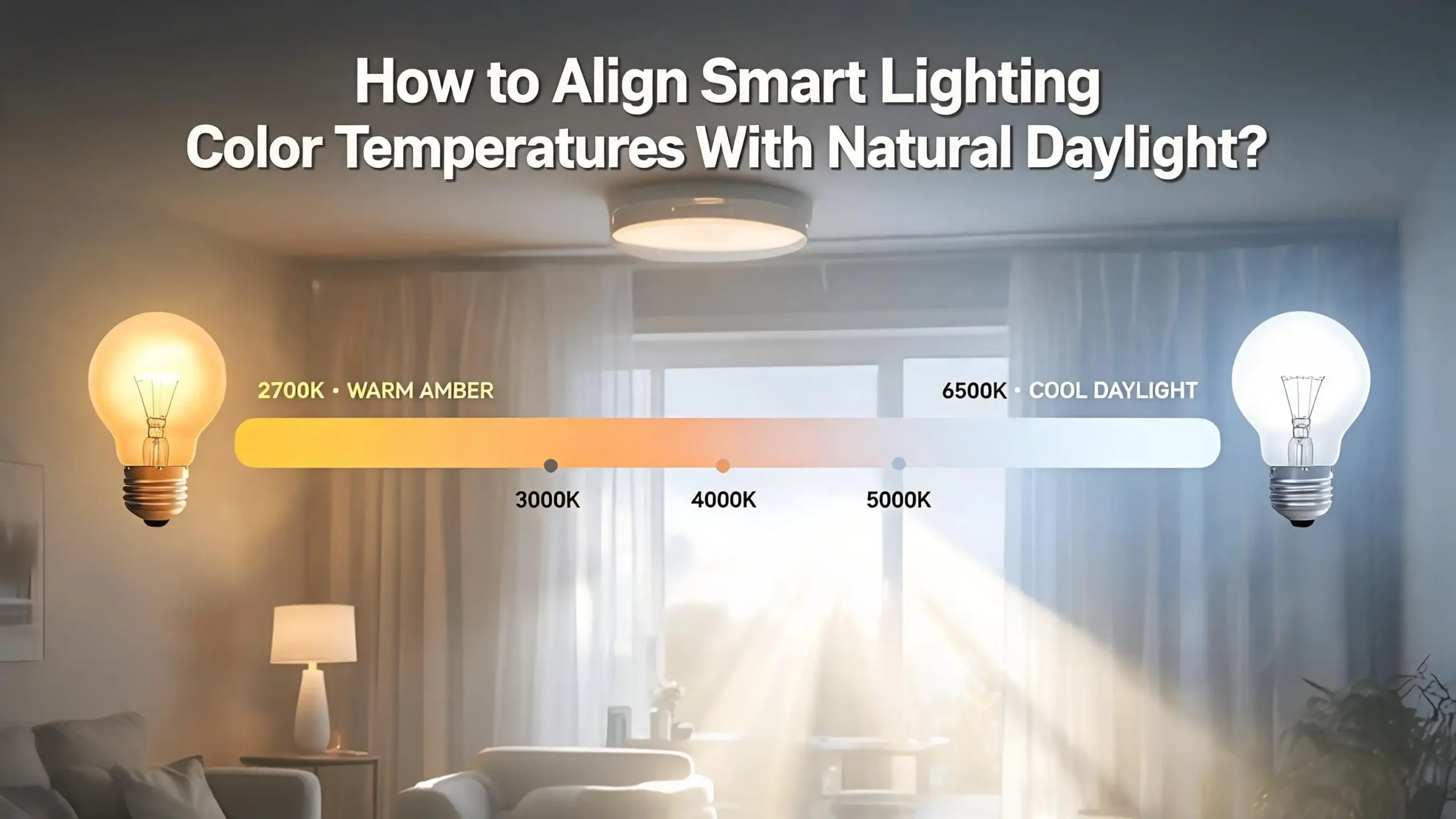
How to Align Smart Lighting Color Temperatures With Natural Daylight?
Sunlight shifts throughout the day. It starts soft and warm at dawn, turns bright and cool by noon, then fades into amber tones at sunset. Your body reads these shifts as signals for energy, focus, and rest. Indoor lights, however, often stay flat and unchanging. That mismatch confuses your eyes, your mood, and your sleep cycle.
Smart bulbs solve this problem. They let you adjust color temperature on a schedule that mirrors the sun. When done right, your home feels more alive, your workdays feel more productive, and your evenings feel calmer.
This guide walks you through every step. You will learn the science, the Kelvin numbers, the schedules, and the small adjustments that make a big difference.
In a Nutshell
- Color temperature is measured in Kelvin (K). Lower numbers like 2200K look warm and orange. Higher numbers like 6500K look bright and blue. Natural daylight ranges roughly from 2700K at sunrise to 6500K at midday, then back down by evening.
- Your circadian rhythm reacts to light color. Cool blue light boosts alertness during the day. Warm amber light supports melatonin production and helps you sleep at night.
- You need tunable white or full color smart bulbs. Fixed temperature bulbs cannot shift. Look for bulbs labeled CCT adjustable, tunable white, or full spectrum smart bulbs.
- Automation matters more than manual control. Set schedules based on local sunrise and sunset times. Apps like Apple Home, Google Home, Philips Hue, and Home Assistant all support adaptive lighting.
- Brightness should change with color. Bright cool light works well at noon. Dim warm light works better after sunset. Always pair the two settings together.
- Start small and expand. Begin with one room, test the schedule for a week, then apply your settings to the rest of your home.
Why Color Temperature Matters in Daily Life?
Light does more than help you see. It tells your brain what time of day it is. Researchers have shown that exposure to cool light in the morning improves focus and mood. Exposure to warm light in the evening helps your body wind down.
When your indoor lighting stays the same all day, your brain loses these natural cues. You may feel tired during work hours or wide awake at midnight. Smart lighting fixes this by changing color temperature on a schedule.
Color temperature is measured on the Kelvin scale. A candle flame sits near 1800K. Midday sunlight sits near 5600K to 6500K. A standard warm white bulb sits around 2700K. Each number creates a different mood and a different biological response.
You do not need to memorize every value. You just need to know that warm light relaxes you and cool light energizes you. Once you understand that, the rest of the setup becomes easy.
Understanding How Natural Daylight Shifts Through the Day
Natural daylight is not one fixed color. It changes from sunrise to sunset based on the angle of the sun. Knowing this pattern helps you copy it indoors.
At sunrise, light passes through more of the atmosphere. This filters out blue wavelengths and leaves warm orange tones around 2700K to 3500K. By mid morning, the sun rises higher and the light grows cooler, around 4000K to 5000K.
At solar noon, the sun shines almost straight down. The light reaches its coolest and brightest point, around 5500K to 6500K. Some experts say true noon daylight sits closer to 5700K than the often quoted 6500K.
In the afternoon, the light slowly warms again. By golden hour, it returns to around 3000K. After sunset, the sky shifts into deep amber and then darkness.
Your smart lighting schedule should follow this same arc. Cool and bright in the middle of the day. Warm and dim at the edges. This simple rule guides every setting you make.
Choosing the Right Smart Bulbs for the Job
Not every smart bulb can match daylight. Some only switch on and off. Others only dim. You need bulbs that can shift their white color temperature.
Look for these labels on the box or product page: tunable white, CCT adjustable, white ambiance, or full color RGBW. These bulbs cover a range from warm to cool white. Most quality options span 2200K to 6500K.
Brands that offer strong tunable white options include Philips Hue White Ambiance, LIFX, Nanoleaf Essentials, Sengled, Wiz, and Govee. All of them connect to a hub or directly to your Wi Fi.
Check the color rendering index too. A CRI above 90 means colors in your room look natural under the bulb. Low CRI bulbs make food, skin, and fabrics look dull or off. This matters more than people realize.
Also check the lumen output. A bulb that only reaches 800 lumens may feel dim at noon settings. Choose bulbs with at least 800 to 1100 lumens for living rooms and kitchens.
Mapping Out Your Daily Lighting Schedule
A good schedule mirrors the sun. You can build one in any smart home app. Most apps let you set time blocks or sun based triggers.
Here is a simple starting schedule you can adapt:
Sunrise to 9 AM: Start at 2700K and rise to 4000K. Brightness ramps from 30 percent to 70 percent. This wakes you gently without shocking your eyes.
9 AM to 12 PM: Move from 4000K to 5500K. Brightness rises to 100 percent. This matches your body’s natural peak alertness.
12 PM to 3 PM: Hold steady at 5000K to 5500K. Keep brightness high. Use this block for deep work or chores.
3 PM to sunset: Slowly drop from 5000K to 3500K. Lower brightness to 70 percent. This signals your body that the day is ending.
Sunset to 9 PM: Move to 2700K. Drop brightness to 40 percent. Warm tones support melatonin.
9 PM to bedtime: Settle at 2200K. Dim to 15 to 20 percent. Avoid any blue light during this window.
Using Sunrise and Sunset Triggers Instead of Fixed Times
Fixed clock times work, but they ignore the seasons. In summer, the sun rises early. In winter, it rises late. Your schedule should shift with these changes.
Most smart home platforms let you anchor automations to sunrise and sunset. Apple Home, Google Home, Amazon Alexa, SmartThings, and Home Assistant all support this feature. You just enter your location and the app pulls the daily sun times.
For example, you can set your warm wake up scene to start 30 minutes before local sunrise. That way, your bedroom glows softly while it is still dark outside. The effect feels natural and gentle.
Sunset triggers work the same way. Set your warm evening scene to begin 60 minutes before sunset. By the time it gets dark, your home already feels calm.
This method removes the need to update schedules every season. Your lights track the sun automatically, all year round. It is one of the most powerful features of smart lighting and one of the most underused.
Setting Up Adaptive Lighting in Popular Smart Home Apps
Most major platforms now include built in adaptive lighting. You do not need extra software to get started.
Apple Home offers Adaptive Lighting for compatible bulbs. Open the Home app, tap a bulb, then tap the color wheel and select Adaptive Lighting. Apple handles the shifts automatically based on time of day.
Philips Hue has a feature called Natural Light. Open the Hue app, go to Automations, and turn it on. The bulbs will shift from energizing morning tones to relaxing evening tones without input.
Google Home lets you create routines with sunrise and sunset triggers. You can set color and brightness for each time block.
Home Assistant offers the most control. The Adaptive Lighting integration calculates color and brightness based on solar position. It works with almost any smart bulb brand. Power users love it because they can tweak every value.
If you use Alexa, you can create routines through the Alexa app. Combine time triggers with light scenes. The interface is less elegant but it works fine.
Picking the Right Color Temperature for Each Room
Different rooms have different jobs. Your schedule should respect that.
Kitchen and home office: Lean cooler during work hours. Use 4500K to 5500K from morning through afternoon. Cool light supports focus and helps you see fine details like recipes or text.
Living room: Stay flexible. Use 4000K during the day for reading or chores. Drop to 2700K in the evening for movies and conversation.
Bedroom: Keep it warm most of the time. Use 3000K in the morning and 2200K in the evening. Avoid cool light here, especially after dark.
Bathroom: Use cool light in the morning for grooming. A setting of 4000K to 5000K helps with shaving and makeup. Switch to warm light at night to avoid waking up fully during late visits.
Hallways and stairs: Use neutral tones around 3500K. They feel welcoming without being too bright or too warm.
You can also create scenes for special moments. A 2200K dinner scene feels intimate. A 5500K cleaning scene helps you spot dust. Mix and match as needed.
Matching Brightness Levels With Color Temperature
Color temperature and brightness work as a team. One without the other feels unnatural.
Think about a sunset. The sky turns warm orange, and the light gets dimmer. Now imagine a sunset that stayed full brightness. It would feel wrong and even uncomfortable.
Your indoor lighting should follow the same pairing rule. Cool tones go with high brightness. Warm tones go with low brightness. This is sometimes called the Kruithof curve, a guideline from lighting research.
In practice, that means a 5500K bulb should sit near 100 percent brightness during the day. A 2200K bulb should sit near 15 to 25 percent at night. Mixing high brightness with warm tones often looks orange and harsh. Mixing low brightness with cool tones often looks gloomy.
Most smart home apps let you set both values in the same automation. Always link them. When you create a scene, save both color and brightness together. This small habit prevents many lighting mistakes.
Reducing Blue Light in the Evening for Better Sleep
Blue light is the part of the spectrum that suppresses melatonin. Cool white bulbs emit a lot of it. That is great for daytime energy but bad for evening rest.
After sunset, your bulbs should drop below 3000K. Below 2500K is even better. Some bulbs can reach 1800K, which mimics candlelight and emits very little blue.
Pair this with dim brightness. A bright warm bulb still emits enough blue to affect sleep. Aim for warm tones under 30 percent brightness in the hour before bed.
You can also use scenes to enforce this rule. Create a Night scene that locks all bedroom and living room lights at 2200K and 20 percent. Trigger it automatically two hours before your usual bedtime.
If you read in bed, choose a small lamp with a low Kelvin bulb. Skip overhead lights at night when possible. Lower light angles feel calmer and disturb sleep less. Your eyes evolved to read sunset light coming from the horizon, not from above.
Avoiding Common Mistakes That Break the Effect
Smart lighting can fail when small details go wrong. Watch for these traps.
Mixing different bulb brands in one room. Each brand renders color slightly differently. A 4000K Hue bulb may not match a 4000K Wiz bulb. Stick with one brand per room when possible.
Forgetting non smart fixtures. A standard 2700K bulb in your hallway will clash with your tuned bedroom. Either swap it out or accept the mismatch.
Setting schedules without testing them. Run your schedule for a few days. Adjust based on how the light actually feels. Numbers on paper rarely feel right on the first try.
Ignoring window light. Sunlight pouring through a window mixes with your bulbs. In rooms with strong daylight, your bulbs only need to support the natural light, not replace it.
Using cool light at night for convenience. Many people leave kitchen lights at 5000K during late snacks. That single habit can delay sleep by an hour. Switch to warm scenes after dinner.
Combining Smart Lighting With Natural Window Light
Your windows are your best lighting tool. They give you free, full spectrum daylight that no bulb can fully match.
Position your desk or favorite chair near a window when possible. During the day, let natural light do most of the work and use bulbs only to fill in shadows.
On cloudy days, your bulbs need to work harder. Increase brightness and lean slightly cooler to make up for the gray sky. On bright sunny days, dim your bulbs or turn off any that overlap with sun patches.
Use light colored walls and ceilings. They bounce daylight deeper into the room. A white ceiling can double the effective daylight in a space. Dark walls absorb light and force your bulbs to compensate.
Add sheer curtains to soften harsh midday sun. Use blackout curtains for bedrooms to keep early summer sunrises from waking you too soon. Your smart lights then take over the wake up role on your chosen schedule.
Troubleshooting Color Inconsistencies Across Rooms
Even with the best setup, rooms can look slightly different. Here is how to fix that.
Check that all bulbs are on the same firmware. Outdated firmware sometimes causes color drift. Update bulbs through their app once a month.
Calibrate scenes by eye, not by numbers. A 3000K bulb behind a fabric lampshade looks warmer than a bare 3000K bulb. Adjust the Kelvin value until both bulbs match visually, not numerically.
Watch for dimming differences. Some bulbs shift color when dimmed. A bulb set to 3000K at 100 percent may look like 2700K at 20 percent. Test each brand to learn its behavior.
Account for paint color. Warm beige walls reflect warm light and amplify the effect. Cool gray walls do the opposite. Your bulb settings should adapt to your wall color, not fight it.
If two rooms must connect visually, like an open kitchen and living room, run them on the same schedule. Save them as a group in your app so any change applies to both at once.
Building a Lighting Routine That Supports Your Body
The final step is making your schedule feel personal. Generic schedules work, but your body has its own rhythm.
Track how you feel for a week. Do you feel groggy in the morning? Try a steeper brightness ramp at sunrise. Do you struggle to sleep? Push your warm evening scene earlier.
If you work night shifts, flip the schedule. Use cool bright light during your work hours, even if they fall at night. Then use warm dim light during your sleep prep, even if it falls during daylight. Your circadian system follows light cues more than the clock.
If you have kids, set bedroom scenes that match their bedtimes. A 2200K nightlight at 5 percent works well for most children. It gives just enough light for safety without disturbing sleep.
For shared spaces, build a compromise schedule. Lean slightly warmer than the average person wants. Most people enjoy warm light, while only some people miss cool light. Comfort tends to win over precision in family homes.
Frequently Asked Questions
What is the best color temperature for waking up in the morning?
A range of 2700K to 4000K works best for waking up. Start warm at sunrise and slowly shift cooler over 30 to 60 minutes. This mimics the way real daylight builds and prevents the shock of sudden bright light.
Can regular LED bulbs match natural daylight without smart features?
Standard LED bulbs only emit one fixed color temperature. They cannot shift through the day. You can buy separate bulbs for different times and swap them, but a tunable white smart bulb is far easier and more effective.
How many Kelvin is true natural daylight?
True daylight changes throughout the day. It runs about 2700K at sunrise and sunset, around 5000K in mid morning and mid afternoon, and around 5500K to 6500K at solar noon. Many experts list 5600K as a common average.
Do I need full color RGB bulbs or just tunable white bulbs?
Tunable white bulbs are enough for daylight matching. They shift along the warm to cool axis. Full color RGB bulbs add red, green, and blue options but cost more. Choose color bulbs only if you want mood lighting and accent colors too.
Will smart lighting actually improve my sleep?
Many users report better sleep within one to two weeks of using warm dim light in the evening. The effect comes from reduced blue light exposure before bed. Results vary by person, but the science behind circadian lighting is well supported.
How often should I update my lighting schedule?
Use sunrise and sunset triggers so your schedule adjusts automatically year round. Review your settings every few months to see if any room feels off. Small tweaks once a season usually keep everything aligned with your routine.